HITRUST CSF Certified
Free guide for health system data, analytics, and AI leaders

Cut duplicate patient records at the source.

Most duplicates start the same way: a patient shows up under a slightly different name, address, or phone number, and a system built for exact matches creates a second record. This guide gives your team 10 concrete steps to stop that before it multiplies across the EHR, the CRM, and every model built on top.

  • ✓Where duplicates are born, and how to stop them at registration, scheduling, and the call center
  • ✓Why exact-match rules miss the records that matter most
  • ✓How to give stewards a confidence score instead of a guess
  • ✓How to tie duplicate rate to the numbers leadership already tracks
45%

of large hospitals say they can't reliably identify the same patient across every system they run.
‍Source: U.S. Government Accountability Office
Get the free guide
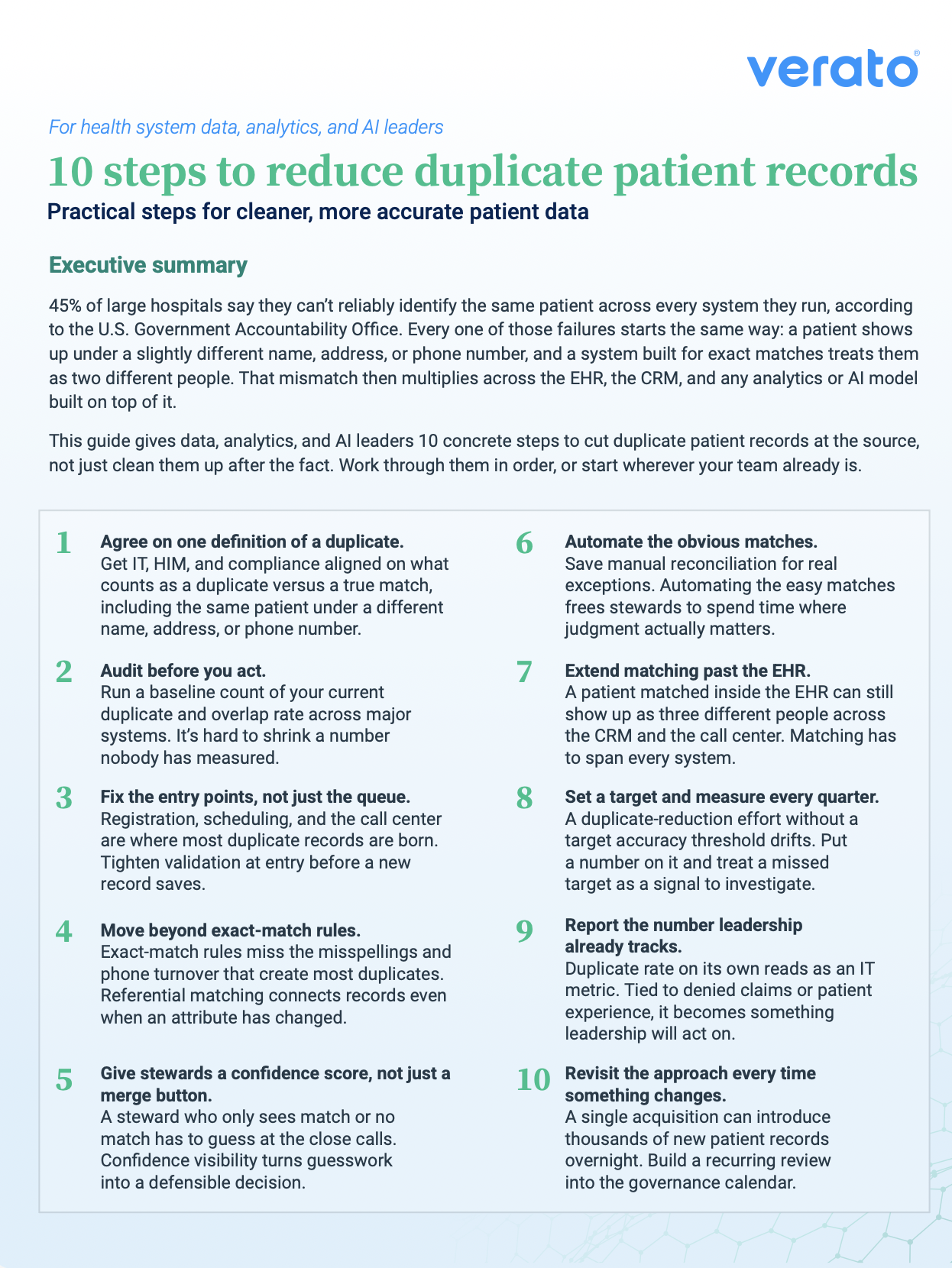
10 steps to reduce duplicate patient records
What's inside

Ten steps. Start anywhere.

Each step fits on a line and names who owns it. Work through them in order, or start wherever your team already is.

1
Agree on one definition of a duplicate.
Align IT, HIM, and compliance on what counts as a duplicate versus a true match.
2
Audit before you act.
Baseline your duplicate and overlap rate across major systems.
3
Fix the entry points, not just the queue.
Tighten validation at registration, scheduling, and the call center.
4
Move beyond exact-match rules.
Catch the misspellings and phone turnover exact matching misses.
5
Give stewards a confidence score.
Turn guesswork on close calls into a defensible decision.
6
Automate the obvious matches.
Save manual reconciliation for real exceptions.
7
Extend matching past the EHR.
One patient can still be three people across the CRM and call center.
8
Set a target and measure every quarter.
Treat a missed target as a signal to investigate.
9
Report the number leadership already tracks.
Tie duplicate rate to denied claims or patient experience.
10
Revisit the approach when something changes.
Build a recurring review into the governance calendar.
24%
more accurate than alternative matching approaches, independently verified.
Source: Regenstrief Institute, 2022
87%
reduction in the potential-match queue at a New York health system after adopting referential matching.
Source: Verato case study